Taxonomy
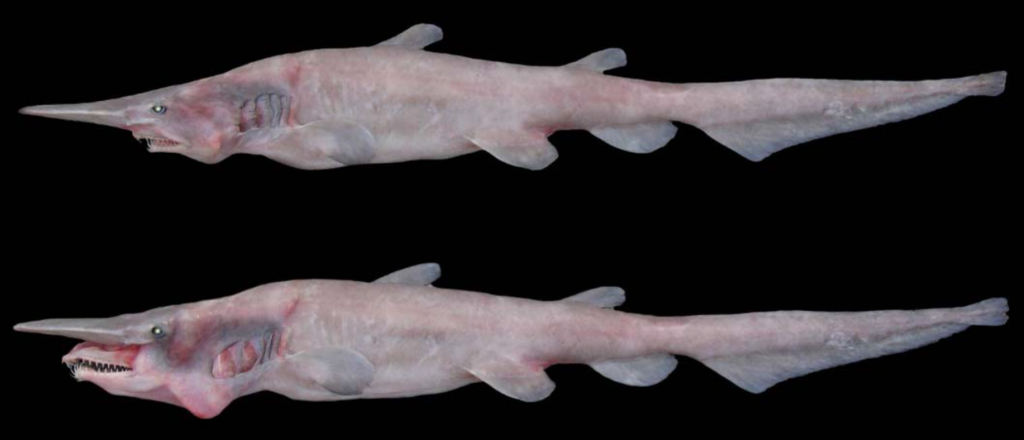
- Animal: Goblin Shark
- Domain: Eukaryota
- Kingdom: Animalia
- Phylum: Chordata
- Class: Cartilaginous Fishes
- Order: Lamniformes
- Family: Mitsukurinidae
- Genus: Mitsukurina
- Species: Mitsukurina Owstoni
Living Space
The Goblin Shark are rare, deep-sea sharks that live worldwide in the Atlantic, Pacific, and Indian Oceans. They typically inhabit the upper continental slopes at depths of 270-960 meters (890-3,150 feet).
3 Adaptive Traits
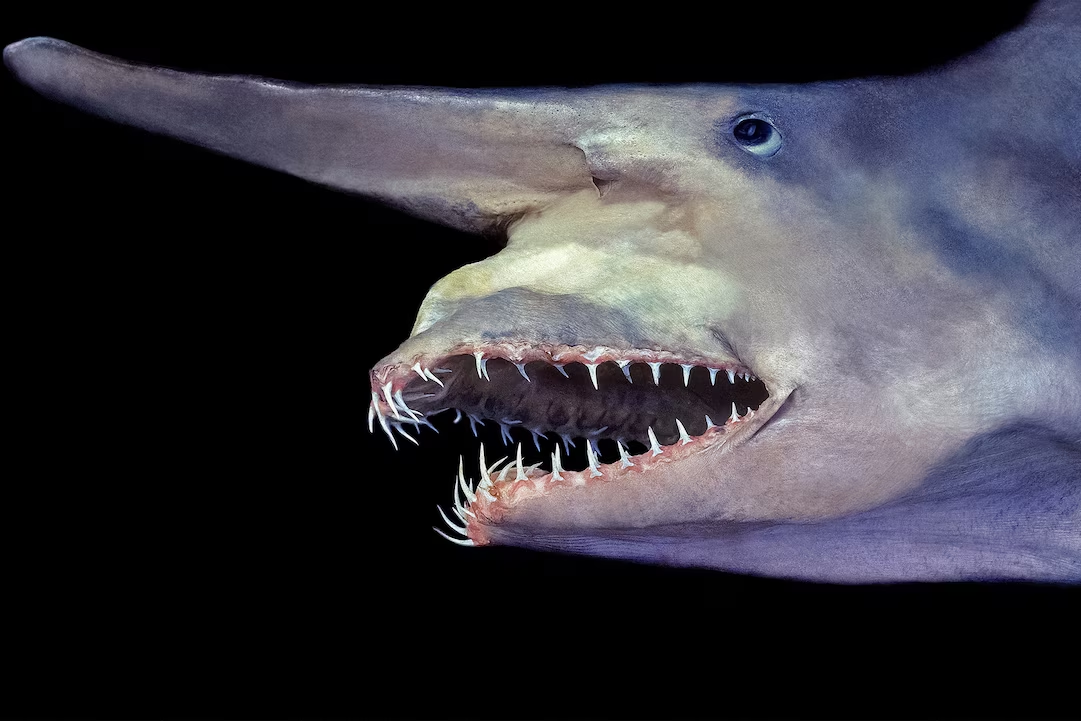
- Highly protrusible jaw mechanisms for rapid prey capture
- Electroreceptive snouts to detect prey without sight
- Low-density, oily bodies for energy-efficient. stealthy cruising
Goblin sharks adaptive help them to survive the extreme, high pressure, and dark environment of the deep sea.
Reproductive System
Goblin sharks reproductive rituals are almost entirely unknown. Due to the fact that goblin sharks live in deep-sea waters, no pregnant female has been officialy examined. Mating has also not been observed. However, goblin sharks are presumed to be ovoviviparous (eggs hatch inside the mother, who gives birth to live young). This is only an assumption because this is how most sharks give birth to their young.
Anatomical Structures
Skeletal structure: The goblin shark has a specialized, low-density skeleton composed of cartilage rather than bone, with poorly calcified, weak structures adapted for deep-sea energy conservation.
Digestive system: The goblin shark has a specialized digestive system adapted for deep-sea, low-energy scavenging and predation. It uses rapid, protrusible jaws for slingshot feeding to swallow prey whole, followed by intense stomach acid and a spiral valve intestine for efficient nutrient absorption.
Respiratory system: Goblin sharks use a typical respiratory system, relying on five pairs of gill slits to extract dissolved oxygen from deep-sea water. As a deep-sea, relatively slow-moving species, they likely use a combination of ram ventilation (swimming with their mouths open) and buccal pumping to move water over their gills.
Circulatory system: The goblin shark has a closed, single-circuit circulatory system with a two-chambered heart (atrium and ventricle) located near the head. Due to low blood pressure, its pink color comes from blood vessels showing through translucent skin. It is a slow-swimmer with limited vascular adaptations for maintaining high body heat.
Social Patterns
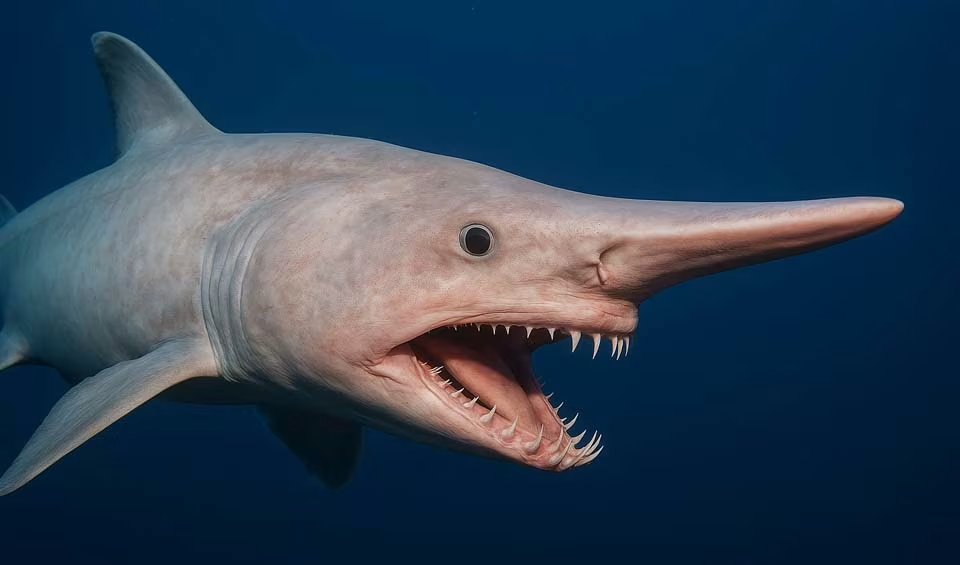
Once again, this is a topic of what we know very little about. The goblin sharks have almost no known social patterns. From what we have been able to observe, goblin sharks tend to be solitary creatures, rarely seen in groups.
Activity Patterns
We don't know much about the activities of goblin sharks. What we do know is that the do the activity called "slingshot feeding". They protrude their jaw to ambush their prey.
Feeding
What it eats: The goblin shark preys on a variety of creatures, such as bony fish (rattails and dragonfish), cephalopods (squid and octopus), and crustaceans (isopods and crabs).
How it eats: If you've been reading my website, then you would remember when I mentioned "slingshot feeding". Slingshot feeding is the act of protruding the jaw at speeds of up to 3.1 meters per second to ambush their prey.
How it gets its food: The goblin shark is an ambush predator that swims slowly in the deep sea, using its nose to detect prey before rapidly projecting its jaw to grab fish, squid, and crustaceans.